Introduction
Starting in scientific research can feel confusing, especially when you are still at the beginning. There are too many papers, too many terms, too many methods, and sometimes it feels like everyone understands the field except you. But the truth is that research is not built overnight. It is built step by step, through reading, practice, mistakes, and continuous improvement.
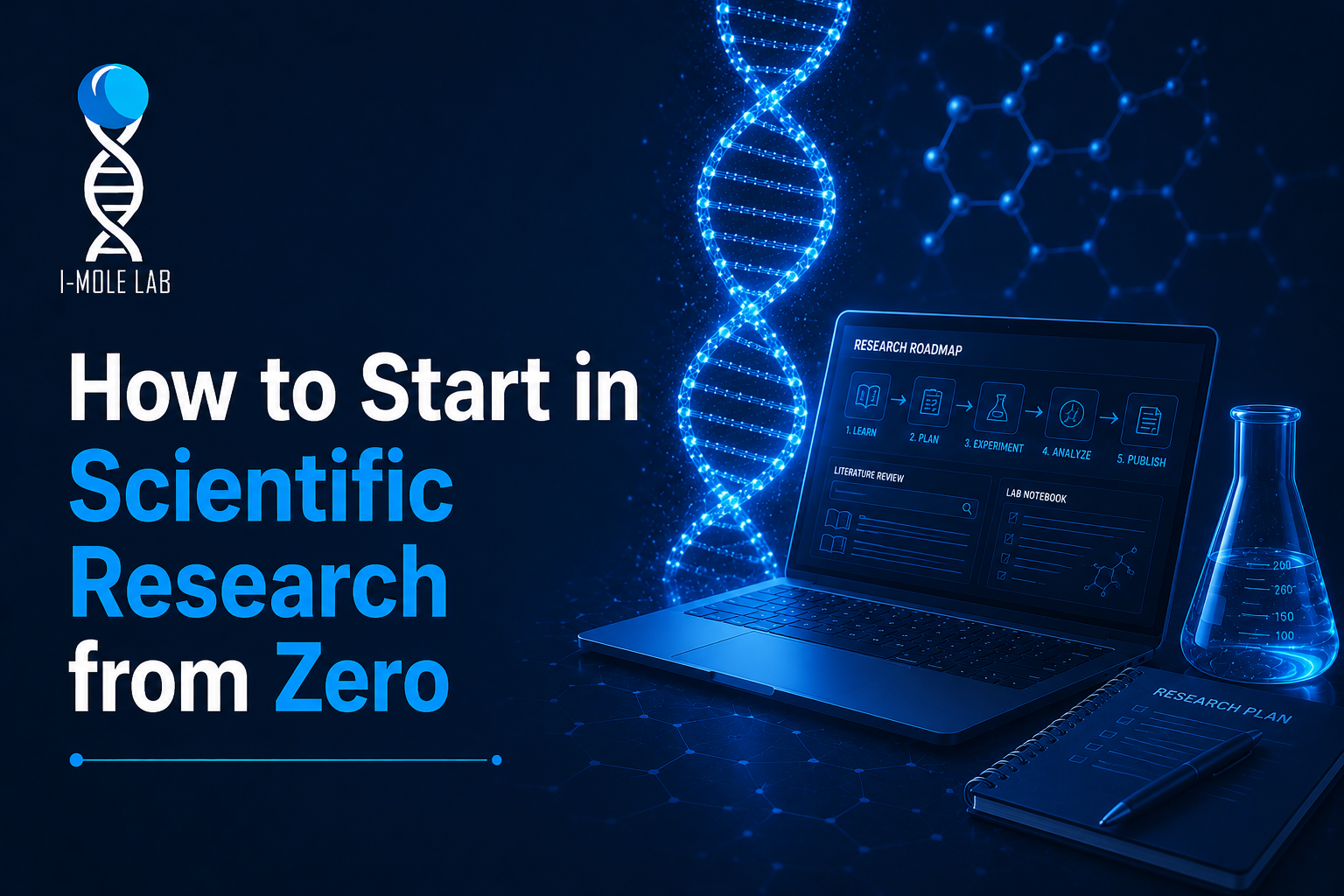
If you are starting from zero, you do not need to become an expert in one week. What you need is a clear roadmap. This article explains three main stages that can help you move from being completely lost to becoming someone who can search, read, understand, write, choose a specialty, and eventually build a real research direction.
Stage One: Preparation
The first stage is preparation. This is the foundation. At this point, your main goal is not to publish papers or join advanced projects immediately. Your goal is to learn how to search correctly, how to read a paper, how to understand figures and graphs, and how to build the basic language of science.
1. Learn how to search properly in your field
The beginning is always search. Many students waste a lot of time because they do not know how to reach the right scientific information. Searching on Google or Google Scholar is not just writing one word and clicking enter. It is a skill. You need to know how to choose keywords, how to use specific search terms, how to filter results, and how to recognize reliable sources.
Start by learning how to search using the correct scientific terms in your specialty. Try different combinations of keywords. Search for review articles first if the topic is new to you, because reviews give you the bigger picture before you enter the details of original research papers.
Useful starting video: https://youtu.be/49DvLTS-WSQ?si=72RQwNtO3SGg-zyu
2. After finding a paper, learn how to read it
Finding the paper is not enough. The real challenge is understanding it. At the beginning, do not treat a paper like a novel that must be read from the first line to the last line in order. Scientific papers have a structure, and you need to learn how to deal with that structure.
Start with the abstract to understand the general idea. Then look at the figures and tables because they often contain the real message of the paper. After that, read the conclusion and discussion to understand what the authors think their results mean. Then go back to the methods when you need to understand how the experiment or analysis was done.
Useful video on reading papers: https://youtu.be/CxttxeXI_yM?si=kUG2CYFEWy26h6Ly
You will also face graphs and plots that are not clear at first. This is normal. Understanding scientific figures is a separate skill. You need to know the difference between bar charts, scatter plots, box plots, heatmaps, survival curves, error bars, and other common figures. Once you understand the graph, the paper becomes much easier.
Useful lecture on common scientific graphs: https://youtu.be/UPtNwpyuA4I
3. Dissect one paper and rewrite it three times
This is one of the strongest exercises you can do. Do not just read a paper and close it. Choose one important paper and work on it deeply. The goal is not memorization. The goal is to train your brain to understand, analyze, write, and think like a researcher.
First time: deep reading and rewriting in the same style
Read the paper carefully. Understand every section: the introduction, aim, methodology, results, discussion, and conclusion. Ask yourself why each technique was used, how it was performed, what alternatives could have been used, and what the results really mean.
After that, rewrite the paper in a style close to the original. This step helps you fix the information in your mind and understand the structure of scientific writing.
Second time: change the style but keep the idea and results
Now rewrite the same paper using your own words. Keep the same idea, same techniques, and same results, but express them in your own writing style. This is where you begin to develop your scientific voice.
This step teaches you that scientific writing is not copying. It is organizing ideas clearly and presenting them in a logical way.
Third time: change the technique, style, and expected results hypothetically
This is the advanced part. Imagine that you want to redesign the same study using a different technique or a different experimental design. What would you change? What results would you expect? What limitations might appear?
You can write a hypothetical version of the study with new methods and expected results. These results are only for training and thinking. They must never be presented as real data. This exercise may take three weeks to one month for one paper, but it can completely change your level.
Important note on research ethics
There is a big difference between training and real research. Writing hypothetical results is useful as a learning exercise, but it is not real data. You must never publish, submit, or present imaginary results as if they were real. Scientific research is built on honesty before intelligence.
If you are a biotechnologist or in a related field
If your background is biotechnology, biology, pharmacy, agriculture, bioinformatics, or a similar field, try to build your knowledge of essential techniques. Learn the basics of PCR, qPCR, sequencing, cloning, protein expression, cell culture, molecular docking, data analysis, and other tools related to your field.
Playlist for learning more techniques: https://youtube.com/playlist…
Essential skills to build in parallel
Statistics and data analysis are not optional. They are keys to understanding almost any scientific paper. If you understand statistics, you will know what each graph means, why a specific statistical test was used, and whether the results are actually strong.
After reading your first ten papers with focus, you will start noticing repeated patterns: common figures, common analyses, repeated methods, and repeated ways of presenting results. This is where scientific reading becomes easier.
Follow scientific updates regularly
A good researcher does not only read old papers. You also need to follow what is happening now. Try to check scientific news and research websites daily or weekly. These websites are not all equal in scientific strength, but they can help you discover new topics and then return to the original sources.
Useful websites include Phys.org, IFLScience, Science, Nature, Cell, ScienceAlert, New Scientist, MIT News, ScienceDaily, GEN, MEMBS, and The Scientist. Always verify important claims by checking the original research paper.
Reading is not enough: apply what you learn
Reading opens the door, but application makes the knowledge stable. After reading a group of papers, try to do something practical: summarize a review, redraw a graph, reanalyze a public dataset, prepare a short presentation, or design a mini project. The more you apply, the faster your understanding becomes real.
Do not be afraid of confusion at the beginning
It is completely normal to feel lost when you read your first papers. It is normal to stop at every term, search for every technique, and need hours to understand one figure. This does not mean you are not suitable for research. It only means you are still building your scientific language.
What you gain after the preparation stage
By the end of this stage, you should be able to search for papers, read them with understanding, identify the aim and method, understand most figures, and write a training paper without real data. More importantly, you will start discovering which specialty attracts you the most.
Stage Two: Selection
After preparation comes selection. Research is too wide, and if you try to enter every direction at the same time, you will become distracted. Choose the area that attracted you during reading, then read more reviews and original papers in that specific area.
After a number of papers, you will notice repeated techniques, repeated questions, and repeated problems. At this point, you should ask: which skill do I need to enter this field? Then try to learn it practically.
How to learn the practical side
You have two main options. The first option is to learn the technique through a paid practical course or training. The second option is to volunteer with a researcher or research group working in the same specialty.
Practical experience is extremely important. Reading alone is not enough. You need to see what happens in real experiments, real data analysis, real troubleshooting, and real teamwork. Once you gain practical exposure, research papers will become much easier to understand because you will know what happens behind each method.
Stage Three: Visibility and Growth
After understanding and selection comes visibility. This does not mean superficial fame. It means building a clear academic and professional presence. Continue reading new papers, follow researchers and journals in your field, and improve your LinkedIn profile.
LinkedIn can show you what skills are needed in your field. When you look at profiles and job posts, you will understand whether you need more experience, a specific course, a software skill, a laboratory technique, or a publication.
Useful course platforms for beginners
FutureLearn is a good starting point because many courses are light, simple, and beginner friendly. OpenLearn is also useful because it offers free and flexible courses. edX is strong and academic, and you can often audit courses without paying for a certificate. Coursera is excellent, but it may be heavier for beginners, so it can come later when your foundation is stronger.
Use ChatGPT wisely
ChatGPT can help you understand difficult concepts, simplify methods, compare techniques, summarize ideas, and explain graphs. But it should be an assistant, not your only source. Always return to the original paper, textbook, or trusted source when accuracy matters.
Build your own research direction
At this stage, you should start building your own research perspective. This does not happen in one day. It is a cumulative process that comes from reading, practice, discussions, mistakes, and curiosity.
When your direction becomes clearer, you will start building relationships based on it. You may join research teams, collaborate with other students or researchers, attend conferences, and eventually publish your own work.
Publishing and conferences
Scientific publication is the real output of the research journey. Courses, reading, and conferences are important, but original published research is the strongest evidence that you contributed to knowledge.
Conferences are also useful because they expose you to new ideas and help you present yourself. However, original publication remains the most important outcome.
Thinking skills that make you different
During your journey, do not only collect scientific information. Work on your way of thinking. Skills like Digital Thinking, Design Thinking, and Critical Thinking can make you much stronger because they teach you how to analyze, solve problems, and create ideas instead of only following instructions.
Conclusion
Stability in scientific research comes through three stages: preparation, selection, and visibility. First, you learn how to search, read, understand, and write. Then you choose a specialty and build practical skills. Finally, you build your profile, relationships, research direction, and scientific output.
Start even if you are at zero. Read the first paper, understand the first graph, write the first summary, take the first course, contact the first researcher, and repeat. Over time, accumulation will create a difference bigger than you expect.