Concept
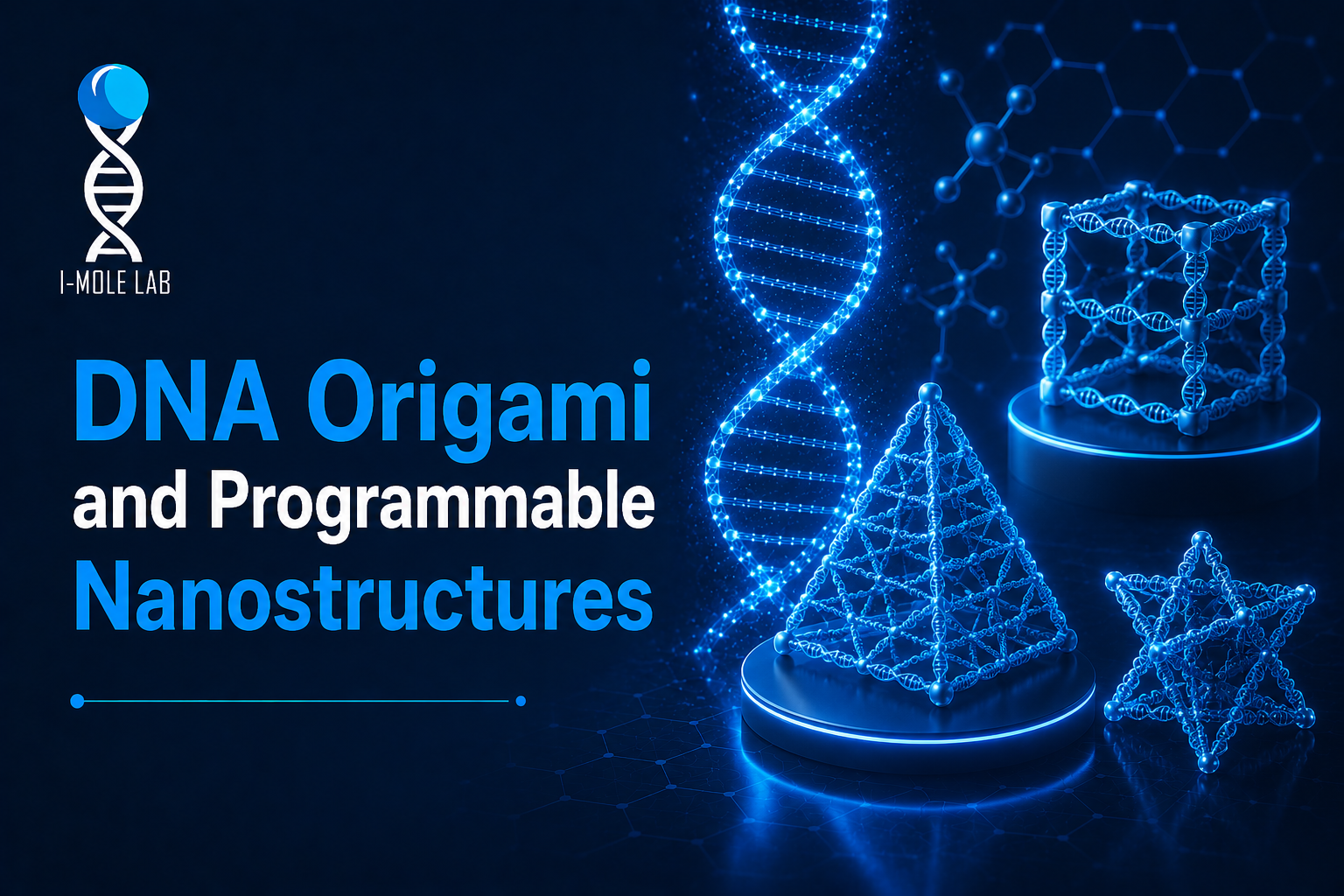
DNA origami is a nanotechnology method in which DNA strands are designed to self-assemble into predetermined two-dimensional or three-dimensional shapes. The method uses the predictable base-pairing rules of DNA. It is called “origami” by analogy to paper folding, but the mechanism is molecular self-assembly rather than mechanical folding by hand.
Historical foundation
The conceptual foundation of DNA nanotechnology came from the idea that branched DNA junctions and lattices could be designed as structural materials. Later, scaffolded DNA origami provided a practical route to build larger shapes by folding a long single-stranded DNA scaffold with many shorter staple strands.
How scaffolded DNA origami works
A long single-stranded DNA scaffold, often derived from bacteriophage M13 DNA, is mixed with many short synthetic oligonucleotides called staple strands. Each staple is designed to bind to specific parts of the scaffold. Together, the staples bring distant scaffold regions into close proximity, forcing the scaffold to fold into the intended structure. Magnesium ions and controlled annealing conditions help stabilize the structure during assembly.
Design and validation
Software such as caDNAno helps design the scaffold path and staple sequences. After assembly, structures are commonly characterized using agarose gel electrophoresis, atomic force microscopy, transmission electron microscopy, dynamic light scattering, fluorescence methods, or cryo-electron microscopy depending on the required resolution. A correct design must be evaluated experimentally because sequence design alone does not guarantee perfect folding.
Applications
DNA origami can position molecules with nanometer-scale precision. This makes it useful for organizing proteins, enzymes, nanoparticles, fluorophores, drugs, aptamers, and other functional components. Proposed and investigated applications include biosensing, molecular rulers, drug-delivery research, vaccine antigen display, nanoelectronics, nanopore control, enzyme cascades, and single-molecule biophysics.
Biomedical limitations
Many biomedical uses of DNA origami remain experimental rather than routine clinical practice. Challenges include nuclease degradation, low stability in some physiological conditions, immune recognition, pharmacokinetics, large-scale manufacturing, purification, cost, cargo loading, targeting specificity, and safety. Protective coatings using polymers, proteins, lipids, peptides, or peptoids are being studied to improve stability and biological compatibility.
Scientific status and caution
DNA origami is scientifically mature as a designable nanoscale research platform, but many translational applications are still under development. Strong articles should distinguish between demonstrated laboratory capability, preclinical potential, and approved clinical use. This distinction prevents overclaiming while still showing the importance of the field.
Key scientific takeaway
DNA origami transforms DNA from a genetic molecule into a programmable construction material. Its greatest strength is spatial precision; its greatest challenge is translating elegant nanoscale design into robust, affordable, and safe real-world systems.
DNA origami: strengths and limits
| Feature | Scientific value | Current challenge |
| Programmable base pairing | Rational design of defined shapes | Misfolding and sequence constraints |
| Nanometer-scale addressability | Precise molecular positioning | Scale-up and purification |
| Biocompatible chemical material | Potential biomedical use | Nuclease degradation and immune effects |
| Functionalization capacity | Can carry drugs, proteins, fluorophores, or aptamers | Cargo stability, release control, and targeting |
| Self-assembly | Parallel fabrication of nanostructures | Batch variability and cost |
References
- Seeman, N. C. (1982). Nucleic acid junctions and lattices. Journal of Theoretical Biology, 99, 237-247.
- Rothemund, P. W. K. (2006). Folding DNA to create nanoscale shapes and patterns. Nature, 440, 297-302.
- Douglas, S. M., et al. (2009). Self-assembly of DNA into nanoscale three-dimensional shapes. Nature, 459, 414-418.
- Chandrasekaran, A. R., et al. (2016). Beyond the fold: Emerging biological applications of DNA origami. ChemBioChem, 17, 1081-1089.
- Wang, S.-T., et al. (2020). DNA origami protection and molecular interfacing through engineered sequence-defined peptoids. Proceedings of the National Academy of Sciences, 117, 6339-6348.
- Nasiri, M., et al. (2024). Improving DNA nanostructure stability: A review. ACS Applied Bio Materials.