Introduction
Many students wait until graduation before asking: What can I put in my CV? The problem is that a CV written at the last minute often looks empty because the student did not document their work, courses, skills, summaries, presentations, or small projects during the university years.
A research portfolio solves this problem. It is not only a file. It is a collection of evidence that shows your growth, interests, skills, and scientific direction. It tells people: I did not only study subjects; I tried, read, analyzed, wrote, learned, and built something step by step.
What is a research portfolio?
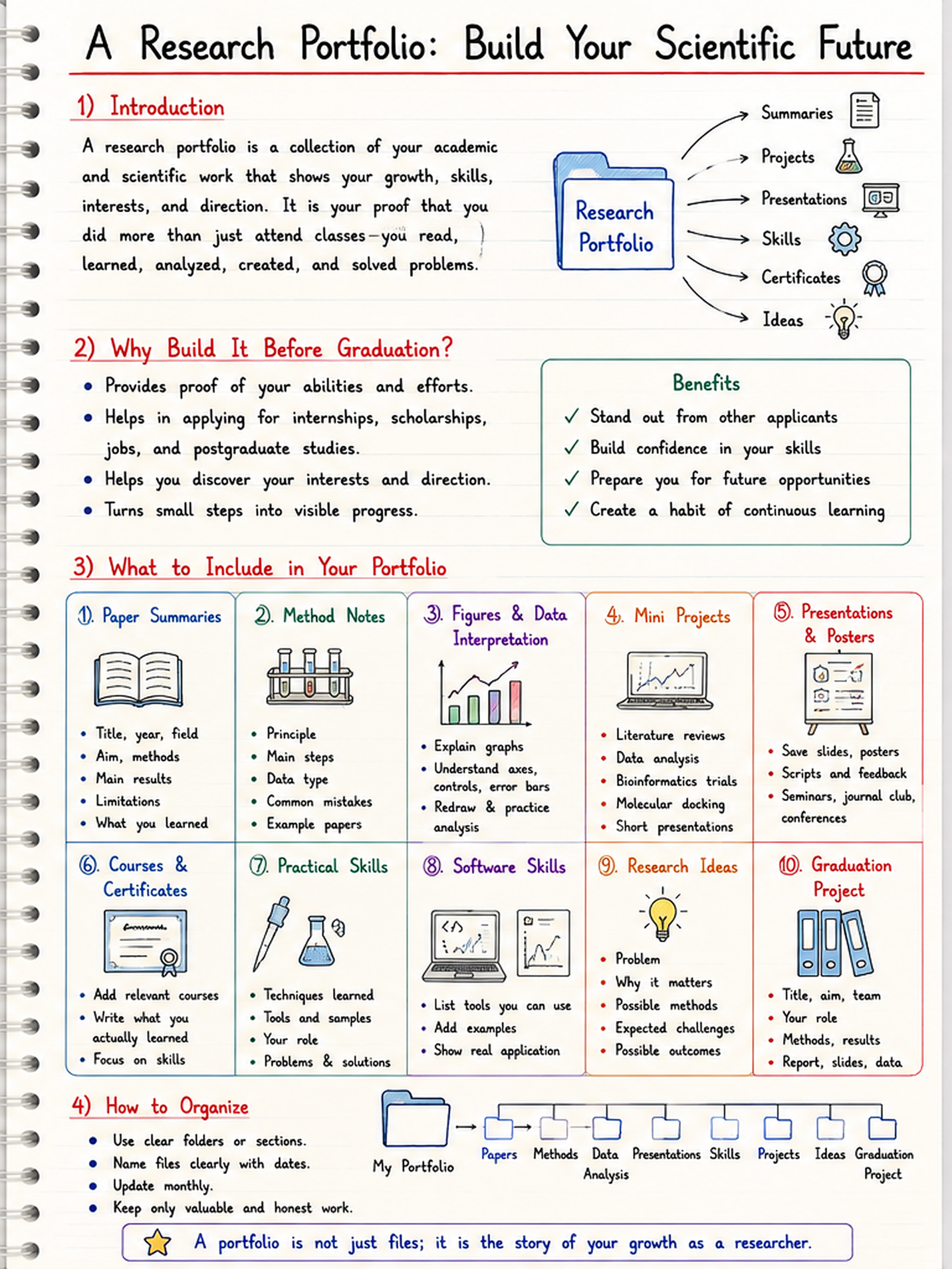
A research portfolio is a structured collection of your scientific and academic work. It may include paper summaries, review notes, presentations, posters, mini projects, data analysis trials, certificates, lab skills, software skills, volunteer work, research ideas, and your graduation project outputs.
It can be a folder on your computer, a Google Drive folder, a Notion page, a personal website, a GitHub profile, or a PDF document. The format is not the most important thing. The important thing is that it is organized, updated, and honest.
Why should you build it before graduation?
Because after graduation, people will ask for proof. They will not only ask what you studied; they will ask what you can do. A portfolio gives you proof. It helps you apply for internships, research assistant positions, scholarships, postgraduate studies, or jobs.
It also helps you understand yourself. When you collect your work in one place, you start noticing your interests. Maybe most of your summaries are about bioinformatics. Maybe you enjoy data analysis. Maybe you are attracted to molecular biology, drug design, microbiology, environmental research, or clinical studies. The portfolio helps you see your direction.
Section One: Paper summaries
Start with the papers you read. For each paper, write a simple summary that includes the title, year, field, aim, methods, main results, limitations, and what you learned. Do not copy the abstract. Write it in your own words.
After ten summaries, you will notice a big change in your reading and writing. After twenty or thirty, you will start building a real scientific background. These summaries can later help you write review articles, prepare presentations, or choose a graduation project.
Section Two: Method notes
Whenever you face a technique you do not understand, make a method note. For example: PCR, qPCR, ELISA, HPLC, GC-MS, Western blot, sequencing, molecular docking, RNA-seq, cell culture, or statistical tests.
In each note, write what the technique is used for, the basic principle, the main steps, the type of data it gives, common mistakes, and examples of papers that used it. Over time, you will create your own mini encyclopedia.
Section Three: Figures and data interpretation
Scientific research is full of figures. So your portfolio should include your attempts to understand and explain graphs. Take figures from papers and write short explanations: What does this graph show? What are the axes? What is the control group? What does the error bar mean? What conclusion can be taken?
You can also practice redrawing graphs using Excel, R, Python, or any suitable tool. This builds your data sense and prepares you for real research work.
Section Four: Mini projects
Do not wait for a big opportunity to start. Create small projects for yourself. A mini project can be a literature review on one topic, a small dataset analysis, a comparison between techniques, a simple bioinformatics pipeline, a molecular docking trial, a survey analysis, or a short scientific presentation.
Mini projects show initiative. They prove that you can move from reading to application, even with limited resources.
Section Five: Presentations and posters
Every presentation you prepare can become part of your portfolio. Save the PowerPoint, poster, script, and feedback. If you presented in a university seminar, journal club, conference, or student activity, document it.
Presentation skills are important because research is not only about doing the work. It is also about explaining the work clearly to others.
Section Six: Courses and certificates
Add relevant courses, but do not collect certificates randomly. A certificate is useful when it supports your direction. For example, if you want bioinformatics, courses in Python, R, genomics, statistics, and data visualization are useful. If you want laboratory work, courses in molecular biology techniques, biosafety, and analytical methods may be more useful.
For each course, write what you actually learned. Do not only save the certificate. Add a short note explaining the skills or concepts you gained.
Section Seven: Practical and laboratory skills
If you learned a laboratory technique, document it clearly. Write the technique name, where you learned it, what samples or tools you used, what your role was, and what problems you faced. If you cannot share sensitive data, write a general description without violating privacy or lab rules.
This section is very important for students in biotechnology, pharmacy, agriculture, science, and medical-related fields. Employers and supervisors care about what you can actually do.
Section Eight: Software and digital skills
Research today needs digital skills. Add the software and tools you can use, such as Excel, GraphPad Prism, SPSS, R, Python, ImageJ, PyMOL, Chimera, AutoDock, Vina, Galaxy, BLAST, MEGA, or any tool related to your specialty.
Do not just write the tool name. Add a small example of what you used it for. For example: used GraphPad Prism to create dose-response curves, used Python to clean a dataset, or used BLAST to compare sequences.
Section Nine: Research ideas
Keep a section for ideas. Many ideas will not be ready, and that is okay. Write the problem, why it matters, possible methods, expected challenges, and possible outcomes. Over time, some of these ideas may become a graduation project, review article, conference abstract, or research proposal.
Section Ten: Graduation project outputs
Your graduation project should have a special place in your portfolio. Add the title, aim, team members, supervisor, your role, methods, results, report, presentation, poster, photos, code, dataset, or any output that can be shared.
If the project cannot be shared publicly, create a safe summary that explains your contribution without revealing confidential details.
How to organize the portfolio
Keep it simple. You can organize it into folders: Papers, Methods, Data Analysis, Presentations, Courses, Practical Skills, Mini Projects, Research Ideas, and Graduation Project. Use clear file names and dates. Do not leave everything scattered on your desktop.
Every month, update the portfolio. Add what you learned, remove weak or repeated files, and improve the descriptions. A portfolio is not built in one day. It grows with you.
How to use it on LinkedIn and your CV
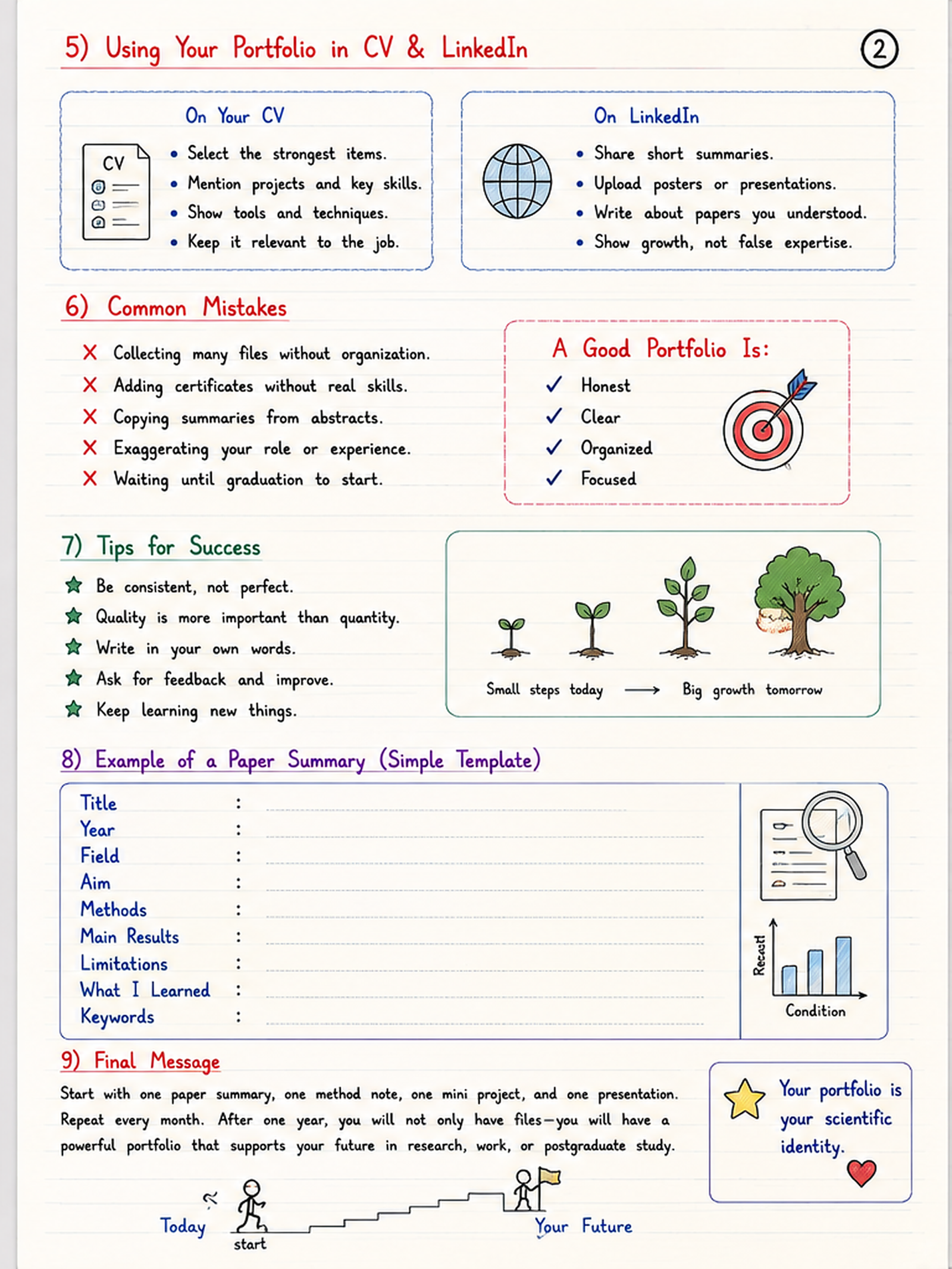
Your portfolio can support your LinkedIn profile and CV. In your CV, you can mention selected projects and skills. On LinkedIn, you can post short summaries of what you learned, upload a poster, share a presentation, or write about a paper you understood.
This does not mean you should post everything. Choose what is professional, useful, and honest. Your goal is to show growth, not to pretend you are an expert before your time.
Common mistakes
The first mistake is collecting many files without organization. The second mistake is adding certificates without real skills. The third mistake is copying summaries from abstracts. The fourth mistake is exaggerating your role. The fifth mistake is waiting until graduation to start.
A good portfolio is honest, clear, organized, and focused. It should show your real level and your real development.
Conclusion
A research portfolio is one of the smartest things you can build before graduation. It helps you understand your direction, prove your skills, prepare for opportunities, and turn small learning steps into visible progress.
Start with one paper summary, one method note, one mini project, and one presentation. Repeat every month. After one year, you will not only have files; you will have a story of growth that can support your future in research, work, or postgraduate study.